
Unfortunately after only a couple months, The Weather Word blog is coming to an end with my abrupt and impending move to State College in a few weeks. If you can stand many, many tweets about baseball and my often sarcastic remarks on popular culture, you can follow me personally on Twitter @muwxguy for occasional updates about weather. Many thanks to our loyal followers here and on Twitter!
.
Wednesday, June 2, 2010

Friday, May 14, 2010
Severe Thunderstorms marching east

Right now, it looks like the time frame for these storms would be anywhere between 5 and 10pm. Obviously, with such a soupy atmosphere, thunderstorms can develop at anytime, but the primary line associated with the cold front should hold off until mid- to late-evening. A severe thunderstorm watch is already up for most of Central PA through this evening, and will likely be expanded further east over the next few hours. The storms that have already popped up across the Appalachian ridges south of State College have a fairly dangerous characteristic -- they all seem to be producing large, damaging hail, at least according to radar. That may be the biggest threat for the next few hours, but as the storms move east, the threat for damaging straight-line winds will increase, and that will likely be our biggest threat this evening.
Of course, tune to local media for the latest updates, and follow out Twitter account for updates as well.
.
Sunday, May 9, 2010
Well Blow Me Down!

| Observing Site | Peak Wind Gust |
| Philadelphia (International Airport) | 55 mph |
| Northeast Philadelphia | 51 mph |
| Allentown (International Airport) | 50 mph |
| Willow Grove | 47 mph |
| Reading | 47 mph |
| Doylestown | 47 mph |
| Allentown (Queen City Airport) | 45 mph |
| Blue Bell | 43 mph |
| Coatesville | 41 mph |
| Pottstown | 40 mph |
So, what's the deal? An area of low pressure, which dragged a cold front through the region earlier this morning, rapidly deepened today as it moved through Northern New England. The corresponding difference in pressure, or gradient, between the deepening low and a high pressure moving east into the Ohio Valley led to the strong winds. Short of giving you an exhaustive meteorology lesson -- many of the details I've probably forgotten since graduation -- know that a strong, or tight, pressure gradient = strong winds. Luckily for those tired of swerving around road debris in their cars, the gradient is lessening, and wind speeds will be lower for Mother's Day. However, as daytime heating commences with the pressure continuing to rise, stronger-than-normal wind gusts can be expected during the day on Sunday, but probably not to the tune of 50 mph again.
One thing you're also going to notice is the drastically cooler weather now that the cold front is history. Hope you bought mom a sweatshirt or a new coat for Sunday as high temperatures across the area will struggle to reach the upper 50s, in fact we'll probably be in the 40s for much of the morning (breakfast in bed rather than a brunch out?). A taste of Winter will come by nightfall, with temperatures plummeting into the 30s by early Monday morning. There is even the potential for a hard freeze across the usually colder areas overnight Sunday, so keep mom's flowers inside. Similarly cool weather can be expected for Monday and Monday night.
A special shout-out to the moms on their special day. Maybe you'll get a Snuggie tomorrow.
.
Tuesday, May 4, 2010
Odds & Ends: Recent Storms, Gulf Oil Spill, Cooler Weather
It's been a while since our last blog post, and a lot of meaningful weather has occurred. The first real taste of Summer heat and humidity roasted the region this past weekend. While it wasn't the first time many of us saw temperatures eclipsing the 90-degree mark (see early April), humidity reared it's ugly head over the weekend, creating that classic, sweaty combo and drawing to mind that classic comment: "It's not the heat, it's the HUMIDITY!"
March of the Storms:
Luckily for those of us longing for drier, cooler air -- or those who wish not to hear that cliche repeated every few minutes -- relief came Sunday night in the form of showers and strong thunderstorms. Those showers and thunderstorms brought locally heavy rainfall, gusty winds and some localized storm damage, which could've been worse had the storms not weakened as they moved into our area.
 The storms on Sunday night were associated with the first of several frontal boundaries that have been marching through the region over the past 48 hours. The cold front that finally brought relief in the humidity department arrived on Monday afternoon with gusty showers. Yet another surface trough feature pushed through today, again associated with a thunderstorm, which many felt the effects of even without receiving a single drop of rain. An outflow boundary, or strong gust front that is generated by a thunderstorm and then pushes out well ahead of it (see the Wikipedia article), swept through most of Bucks and Montgomery counties between 4 and 5pm today. It was even detected on the reflectivity mode of radar (see image to the right), which normally only detects precipitation. Check out that thin, blue line as it pushes out well ahead of the parent thundershower. As it moved through, we saw calm, warm conditions turn suddenly into cooler, gustier conditions. For example, at Doylestown, just outside of our coverage area, temperatures fell from 75 to 63 in an hour (presumably a matter of minutes between observations) on a wind shift from west to northwest with only 0.01" of rain.
If you're yearning for an afternoon of weather that won't be interrupted by sudden showers and wind shifts and outflow boundaries, you'll be in luck... but just for a day. Wednesday will feature bright, sunny skies and temperatures into the lower 80s. Additional frontal boundaries, similar to those we've been experiencing the past few days from what are called "shortwaves," will continue to affect us toward the end of the week. A stronger cold front will usher in unseasonably cool weather by next weekend, but more about that later.
Gulf Oil Spill:
I'm sure by now you've heard about the tremendous disaster occurring in the Gulf of Mexico with the explosion of a BP oil rig and subsequent, significant discharge of oil that is still ongoing. What you may not know is that NOAA, the parent government agency behind the National Weather Service, is largely responsible for tracking and forecasting the trajectory of the 150-mile wide swath of oil. Dubbed "Deepwater Horizon Incident," NOAA's website portal for the disaster is constantly being updated with new information about the disaster as 210,000 gallons of oil continues to be released into the Gulf every day.
While Louisiana and Florida are most imminently under the threat of environmental impacts from the growing oil spill, there are growing concerns that even those with interests along and off the Atlantic East coast could soon have to deal with oil contamination. Strong northwesterly winds, which are expected later this week, could force some of the oil further to the southwest of its release point and into the Loop Current, a swift underwater current that would drive the oil southeast toward the Florida Keys. At this point, it would come in contact with the Gulf Stream and potentially traverse up offshore of the East Coast. Of course this is all theoretical, and dependent on many factors including steering winds, precipitation, and whether or not BP is finally able to shut off that insufferable valve.
Cooler Weather this Weekend:
 As the Montreal Canadiens head into town to face the Flyers this week, another un-welcomed Canadian guest may not be far behind. Behind a strong cold front which is expected to move through early Saturday, cooler-than-normal Canadian air will usher into the area for the beginning of next week. After our low temperatures a few days ago barely edged below 80 degrees, some of us may struggle to reach 60 for a high on Sunday. The image to the right shows the Climate Prediction Center's temperature outlook for early next week, and there's plenty of blue/below normal across the Northeast.
As always, continue to follow our Twitter account, @TheWeatherWord, for more frequent updates you won't always see here on the blog.
.
March of the Storms:
Luckily for those of us longing for drier, cooler air -- or those who wish not to hear that cliche repeated every few minutes -- relief came Sunday night in the form of showers and strong thunderstorms. Those showers and thunderstorms brought locally heavy rainfall, gusty winds and some localized storm damage, which could've been worse had the storms not weakened as they moved into our area.

If you're yearning for an afternoon of weather that won't be interrupted by sudden showers and wind shifts and outflow boundaries, you'll be in luck... but just for a day. Wednesday will feature bright, sunny skies and temperatures into the lower 80s. Additional frontal boundaries, similar to those we've been experiencing the past few days from what are called "shortwaves," will continue to affect us toward the end of the week. A stronger cold front will usher in unseasonably cool weather by next weekend, but more about that later.
Gulf Oil Spill:
I'm sure by now you've heard about the tremendous disaster occurring in the Gulf of Mexico with the explosion of a BP oil rig and subsequent, significant discharge of oil that is still ongoing. What you may not know is that NOAA, the parent government agency behind the National Weather Service, is largely responsible for tracking and forecasting the trajectory of the 150-mile wide swath of oil. Dubbed "Deepwater Horizon Incident," NOAA's website portal for the disaster is constantly being updated with new information about the disaster as 210,000 gallons of oil continues to be released into the Gulf every day.
While Louisiana and Florida are most imminently under the threat of environmental impacts from the growing oil spill, there are growing concerns that even those with interests along and off the Atlantic East coast could soon have to deal with oil contamination. Strong northwesterly winds, which are expected later this week, could force some of the oil further to the southwest of its release point and into the Loop Current, a swift underwater current that would drive the oil southeast toward the Florida Keys. At this point, it would come in contact with the Gulf Stream and potentially traverse up offshore of the East Coast. Of course this is all theoretical, and dependent on many factors including steering winds, precipitation, and whether or not BP is finally able to shut off that insufferable valve.
Cooler Weather this Weekend:

As always, continue to follow our Twitter account, @TheWeatherWord, for more frequent updates you won't always see here on the blog.
.
Saturday, April 24, 2010
Extended Period of Unsettled Weather Ahead
A major storm system that has delivered a plethora of severe weather across our nation's midsection today is moving east and will be impacting our area over the next few days with unsettled weather conditions. While the worst of the weather will remain well to our south and west, it will be a markedly different scene outside from later this evening through Tuesday as compared to the beautiful weather of the last few days.
The History of this Storm:
>> An incredible variation of weather occurred across much of the Rocky Mountain states late Thursday. Several tornadoes were reported on the ground in Eastern Colorado during the early evening hours, then after a strong cold front pushed through, and an upper-level low pressure system moved in. The result was areas of heavy snow late Thursday night into Friday across portions of Wyoming and Colorado with accumulations in some higher-elevation areas over a foot.
 >> Across the Southern Mississippi Valley and portions of the Southeast today, several variables have come together for a "textbook" tornado outbreak. Several strong, long-track tornadoes have been reported across Northeastern Louisiana and Mississippi with several more expected later today. The strongest tornado thus far has torn a path of destruction across Central Mississippi. Emergency managers and storm chasers have reported that the city of Yazoo City, MS has been nearly totally destroyed by a tornado -- the debris from the city was even spotted on radar moving along to the northeast with the tornado.
>> Further northeast today, areas of rain with embedded thunderstorms are occurring across portions of the Tennessee and Ohio river valleys.
>> The first sign of impending inclement weather is already spreading across Southeastern PA. Clouds will thicken and lower as we head into the evening hours. An area of showers that extended well out ahead of the primary storm across Maryland and Southern Pennsylvania a few hours ago has all but dissipated, so we should be rain-free for the next several hours.
>> Rain from weakened areas of thunderstorms (called an MCS, a mesoscale convective system) will likely overspread our area by late evening, say after 7pm, with the heaviest rain occurring a few hours after Midnight. Rainfall amounts of close to an inch are possible by late morning Sunday. There is a chance there could be some embedded thunder and lightning with the rain, however with the best dynamics well to our south and under the stability of night, this is a small threat. Sunday might be a different story.
>> Sunday's forecast is a decidedly trickier one. Southeastern PA right now is on the northernmost borderline for the potential for strong thunderstorms, especially during the afternoon hours. Right now my call would be for frequent showers, with the potential for thunderstorms in the afternoon and evening hours. If everything comes together, we could be looking at the threat for hail and strong winds with some storms. The highest threat will be across more southernmost areas, meaning those closer to Philadelphia or Chester county.
>> Lingering low pressure systems will parade through the area from Sunday night through Tuesday night, meaning Monday and Tuesday will feature plenty of clouds and occasional rain. Not such a nice way to start the work week. Below is a forecast precipitation map through Tuesday night issued by the National Weather Service:
 As always, with the threat of severe weather across the area on Sunday, albeit questionable at this time, check back here and on our Twitter feed, @TheWeatherWord, for updates.
.
The History of this Storm:
>> An incredible variation of weather occurred across much of the Rocky Mountain states late Thursday. Several tornadoes were reported on the ground in Eastern Colorado during the early evening hours, then after a strong cold front pushed through, and an upper-level low pressure system moved in. The result was areas of heavy snow late Thursday night into Friday across portions of Wyoming and Colorado with accumulations in some higher-elevation areas over a foot.

>> Further northeast today, areas of rain with embedded thunderstorms are occurring across portions of the Tennessee and Ohio river valleys.
>> The first sign of impending inclement weather is already spreading across Southeastern PA. Clouds will thicken and lower as we head into the evening hours. An area of showers that extended well out ahead of the primary storm across Maryland and Southern Pennsylvania a few hours ago has all but dissipated, so we should be rain-free for the next several hours.
>> Rain from weakened areas of thunderstorms (called an MCS, a mesoscale convective system) will likely overspread our area by late evening, say after 7pm, with the heaviest rain occurring a few hours after Midnight. Rainfall amounts of close to an inch are possible by late morning Sunday. There is a chance there could be some embedded thunder and lightning with the rain, however with the best dynamics well to our south and under the stability of night, this is a small threat. Sunday might be a different story.
>> Sunday's forecast is a decidedly trickier one. Southeastern PA right now is on the northernmost borderline for the potential for strong thunderstorms, especially during the afternoon hours. Right now my call would be for frequent showers, with the potential for thunderstorms in the afternoon and evening hours. If everything comes together, we could be looking at the threat for hail and strong winds with some storms. The highest threat will be across more southernmost areas, meaning those closer to Philadelphia or Chester county.
>> Lingering low pressure systems will parade through the area from Sunday night through Tuesday night, meaning Monday and Tuesday will feature plenty of clouds and occasional rain. Not such a nice way to start the work week. Below is a forecast precipitation map through Tuesday night issued by the National Weather Service:
.
Saturday, April 17, 2010
Rain Delay: Top iPhone Weather Apps
If you stumbled across this blog hoping for a daily weather forecast, I'm sorry to say you're going to be disappointed. My competition is too great and so much more advanced in delivering you the weather in remarkably fast and easy ways. The days of paging through the newspaper to find the weather page are long past us. In the year 2010, you can get a weather forecast and look at weather data from virtually anywhere (provided you have internet access or cellular reception). In an effort to keep you coming back, even if I don't offer you a daily forecast, I'm going to start writing features every now and then in a segment called Rain Delay, in which we'll look at advancements in meteorology and the technologies which bring you closer to Mother Nature. To kick it off, we'll take a look at applications for one of the world's most popular mobile handsets, the Apple iPhone. Despite a sub-par cellular network by many accounts, the technology offered on this phone, augmented through thousands upon thousands of mobile applications, or "apps," is essential for any meteorologist -- or weather enthusiast -- on-the-go.
Before I begin, I want to say that the names and trademarks off the apps listed below (and Apple's devices) are properties of their respective companies/developers, and I have been in no way compensated for my suggestions/endorsements. If you have an iPhone or iPod Touch and like what you see, I've provided links to download them in the App Store if you click on the title of the app.
 My-Cast Weather ($3.99)
This app is my first destination for weather information on-the-go. The developers at Digital Cyclone have delivered a beautiful, intuitive application that is perfect for anyone who wants a quick, simple look at the weather. Included are detailed current conditions for your current (GPS-enabled) location or any bookmarked location and a seven-day (probably computer-generated) forecast, which includes an hour-by-hour look for the current day. To me, the best feature of this app is a great maps interface, which allows you to view animated radar and satellite data, severe weather statements, as well as plot current conditions on a map that is zoom-able and easy to read. This is definitely my favorite weather app and it's well worth the $4.
 RadarScope ($9.99)
A vital feature of any meteorologist's toolbox is Doppler radar. It's usually one of the first things you see on the morning or evening weathercast, sometimes at the beginning of the newscast (cue the "and let's take a look at the radar" soundbite). With RadarScope you have real-time access to the full suite of products of our nation's 159 high-resolution Doppler radars. Similar software for your desktop computer would run almost $80, so now that intimidating $9.99 price doesn't look so bad. With the intuitive interface, you can easily switch back and forth between radar sites and products ranging from normal reflectivity images, to velocity images to check for possible tornadoes, and estimated rainfall data. If you ever get the gusto to storm chase, this app would probably prove invaluable.
 MyWeather Mobile ($1.99)
This app is definitely used a lot less frequently than my first two selections, but it has several important components. The first is push notifications for severe weather alerts. If a severe weather alert (watch, warning or advisory) is posted for one of the cities you saved in the app, your iPhone will alert you as soon as it is issued in a way similar to receiving a text message. Another feature I like is the ability to customize a list of cities on the home page of the app which shows the current weather, temperature and if there are any valid alerts for that city. By selecting each one, you can easily see the forecast for any of those cities. The radar and graph features in the app leave a bit to be desired, but nonetheless this is an important app in my toolbox, especially in severe weather situations.
 WeatherBug Elite ($0.99)
And finally an app that many of us may already have on our computers, except this is an incarnation which I believe to be a little bit better (no annoying chirping sound!). WeatherBug Elite is the ad-free version of the free app which provides you quick and customizable access to WeatherBug's network of neighborhood weather stations and cams. The interface which delivers the forecast and severe weather warnings is also easy-to-use and well designed. While not my top iPhone weather app, I'm sure it will be for you if you're checking out weather conditions delivered straight from your son or daughter's school.
Now what if you aren't willing to pony up the cash for something you can get for free via mobile internet browsing. I don't blame you now that I realized I have spent quite a bit more than one usually would on programs that are only a few megabytes in total. Luckily, the App Store has several free apps that would satisfy the needs of many mobile weather enthusiasts. The one I recommend is the AccuWeather.com app, which provides quick access to AccuWeather's forecast and alert products.
So what's your favorite mobile weather app? Sound off by commenting and I'll see you next time for another edition of Rain Delay.
.
Before I begin, I want to say that the names and trademarks off the apps listed below (and Apple's devices) are properties of their respective companies/developers, and I have been in no way compensated for my suggestions/endorsements. If you have an iPhone or iPod Touch and like what you see, I've provided links to download them in the App Store if you click on the title of the app.
This app is my first destination for weather information on-the-go. The developers at Digital Cyclone have delivered a beautiful, intuitive application that is perfect for anyone who wants a quick, simple look at the weather. Included are detailed current conditions for your current (GPS-enabled) location or any bookmarked location and a seven-day (probably computer-generated) forecast, which includes an hour-by-hour look for the current day. To me, the best feature of this app is a great maps interface, which allows you to view animated radar and satellite data, severe weather statements, as well as plot current conditions on a map that is zoom-able and easy to read. This is definitely my favorite weather app and it's well worth the $4.
A vital feature of any meteorologist's toolbox is Doppler radar. It's usually one of the first things you see on the morning or evening weathercast, sometimes at the beginning of the newscast (cue the "and let's take a look at the radar" soundbite). With RadarScope you have real-time access to the full suite of products of our nation's 159 high-resolution Doppler radars. Similar software for your desktop computer would run almost $80, so now that intimidating $9.99 price doesn't look so bad. With the intuitive interface, you can easily switch back and forth between radar sites and products ranging from normal reflectivity images, to velocity images to check for possible tornadoes, and estimated rainfall data. If you ever get the gusto to storm chase, this app would probably prove invaluable.
This app is definitely used a lot less frequently than my first two selections, but it has several important components. The first is push notifications for severe weather alerts. If a severe weather alert (watch, warning or advisory) is posted for one of the cities you saved in the app, your iPhone will alert you as soon as it is issued in a way similar to receiving a text message. Another feature I like is the ability to customize a list of cities on the home page of the app which shows the current weather, temperature and if there are any valid alerts for that city. By selecting each one, you can easily see the forecast for any of those cities. The radar and graph features in the app leave a bit to be desired, but nonetheless this is an important app in my toolbox, especially in severe weather situations.
And finally an app that many of us may already have on our computers, except this is an incarnation which I believe to be a little bit better (no annoying chirping sound!). WeatherBug Elite is the ad-free version of the free app which provides you quick and customizable access to WeatherBug's network of neighborhood weather stations and cams. The interface which delivers the forecast and severe weather warnings is also easy-to-use and well designed. While not my top iPhone weather app, I'm sure it will be for you if you're checking out weather conditions delivered straight from your son or daughter's school.
Now what if you aren't willing to pony up the cash for something you can get for free via mobile internet browsing. I don't blame you now that I realized I have spent quite a bit more than one usually would on programs that are only a few megabytes in total. Luckily, the App Store has several free apps that would satisfy the needs of many mobile weather enthusiasts. The one I recommend is the AccuWeather.com app, which provides quick access to AccuWeather's forecast and alert products.
So what's your favorite mobile weather app? Sound off by commenting and I'll see you next time for another edition of Rain Delay.
.
Friday, April 16, 2010
Severe Weather Coverage on Twitter
 After a prolonged period of rather subdued weather, there is once again a threat of strong thunderstorms this evening across the region. As of 5:45pm, a few showers have invaded Southeastern PA, but stronger activity associated with a cold front will threaten later. Some thunderstorms have already produced wind damage across Central and Western PA and that threat will continue as the storms march east across the Keystone state. The one caveat that may prevent us from receiving similar damaging weather is a slightly more stable atmosphere across the Delaware Valley, with temperatures and dew points (two important ingredients to fuel thunderstorms) lower around here than they were earlier out west.
Nonetheless, we invite you to follow our Twitter account, @TheWeatherWord, for updates this evening as the storms move further east. We also invite you to send us any observations of severe weather.
Update (6:00pm):
A backdoor cold front feature is pushing south from New Jersey into portions of SE PA, mainly Bucks county at this point. The air mass behind this front is considerably more stable, with temperatures falling into the lower 60s and dew points dropping well below what is normally needed for thunderstorms. It will be interesting to see how the storms, as they move east, interact with the cooler air mass, however it is looking more and more like the severe weather will elude us to our west. Highest threat remains across far western suburbs (i.e., toward Berks/Lancaster counties). Continue to follow us on Twitter for updates!.
Thursday, April 8, 2010
Strong Thunderstorms possible late Thursday
As forecasted in yesterday's post, many locations cracked that elusive 90° mark on Wednesday. Record highs were established at many surrounding climate stations, including Allentown (92°), Reading (89°) and Trenton (89°). Philadelphia International Airport missed tying the record high of 90° by just a degree. On my way into the house this evening, I noticed the familiar (for July, I suppose) whirring of air conditioners in the neighborhood. Never fear over-burdened electric bill-payers, their use will be temporary as this weekend we will be experiencing much more typical weather for early April. But that of course will come at a cost.
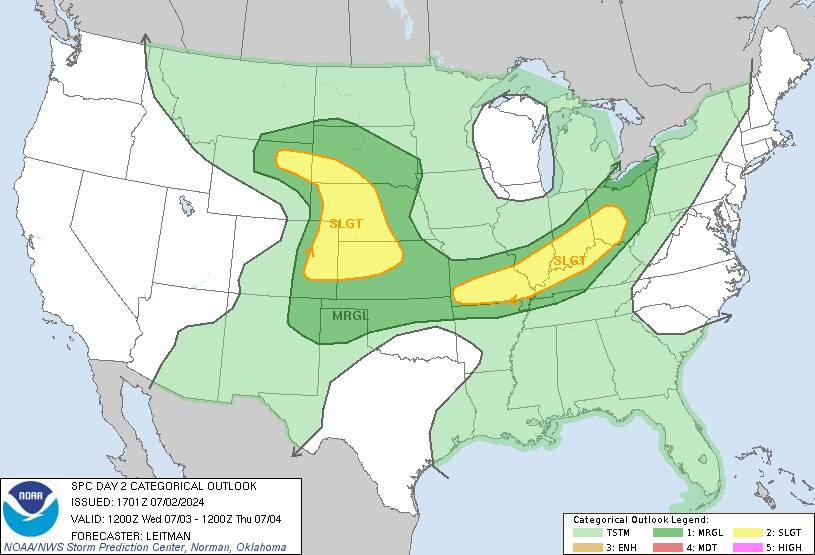 Later this evening, many of us will likely experience the first thunderstorm of the season as a strong cold front pushes through, and some of those storms may be powerful. No doubt you will hear on the newscasts today that we are under a "slight risk for severe thunderstorms." But what does that really mean? First of all, that risk is a forecast issued by the Storm Prediction Center, a nerve-center, if you will, for national 24/7 severe weather forecasting -- brought to you by your tax dollars as a part of the National Weather Service. A slight risk is defined as anywhere between a 15-30% chance of severe hail or wind damage within a radius 25 miles of a point within the risk area. Why 25 miles? That's about the size of a major metropolitan area. Seem low? Well, even though severe storms tend to receive a large amount of media coverage, severe weather is uncommon at any one location. Officially defined (here I go again), a severe thunderstorm is defined as a thunderstorm containing hail at least an inch in diameter or larger and winds of 58 mph or greater.
Now the juicy forecast details. Tomorrow will be another unseasonably warm day, with temperatures getting well into the 80s once again. Some clouds filtering in throughout the day may keep us from getting close to 90° as seen on Wednesday, however with a slight up-tick in humidity, it'll be hard to notice the difference. The first threat of any organized shower or thunderstorm activity across Southeastern PA will come late in the afternoon, probably after 4pm. Right now I would handicap the best time for any thunderstorm activity, potentially strong, to be between 6pm and Midnight. The exact evolution of the current thunderstorm complex over the Ohio Valley, as well as some other minor details, will determine when and where gets the worst of it. I'll post updates on our Twitter account, twitter.com/theweatherword, about any impending hazards.
One good thing we may have on our side is the veil of night. Thunderstorm activity thrives with daytime heat, as this naturally leads to rising air and strong convection. With the loss of sunshine, thunderstorms will have to rely mainly on atmospheric dynamics, rather than rich daytime heat, to survive well into the night. That being said, since this cold front is looking to be very strong, thunderstorms will likely sustain themselves well after dusk. On the other side, high temperatures to close out the week on Friday will probably not break the 50s.
Keep an eye to the sky!
.
Later this evening, many of us will likely experience the first thunderstorm of the season as a strong cold front pushes through, and some of those storms may be powerful. No doubt you will hear on the newscasts today that we are under a "slight risk for severe thunderstorms." But what does that really mean? First of all, that risk is a forecast issued by the Storm Prediction Center, a nerve-center, if you will, for national 24/7 severe weather forecasting -- brought to you by your tax dollars as a part of the National Weather Service. A slight risk is defined as anywhere between a 15-30% chance of severe hail or wind damage within a radius 25 miles of a point within the risk area. Why 25 miles? That's about the size of a major metropolitan area. Seem low? Well, even though severe storms tend to receive a large amount of media coverage, severe weather is uncommon at any one location. Officially defined (here I go again), a severe thunderstorm is defined as a thunderstorm containing hail at least an inch in diameter or larger and winds of 58 mph or greater.Now the juicy forecast details. Tomorrow will be another unseasonably warm day, with temperatures getting well into the 80s once again. Some clouds filtering in throughout the day may keep us from getting close to 90° as seen on Wednesday, however with a slight up-tick in humidity, it'll be hard to notice the difference. The first threat of any organized shower or thunderstorm activity across Southeastern PA will come late in the afternoon, probably after 4pm. Right now I would handicap the best time for any thunderstorm activity, potentially strong, to be between 6pm and Midnight. The exact evolution of the current thunderstorm complex over the Ohio Valley, as well as some other minor details, will determine when and where gets the worst of it. I'll post updates on our Twitter account, twitter.com/theweatherword, about any impending hazards.
One good thing we may have on our side is the veil of night. Thunderstorm activity thrives with daytime heat, as this naturally leads to rising air and strong convection. With the loss of sunshine, thunderstorms will have to rely mainly on atmospheric dynamics, rather than rich daytime heat, to survive well into the night. That being said, since this cold front is looking to be very strong, thunderstorms will likely sustain themselves well after dusk. On the other side, high temperatures to close out the week on Friday will probably not break the 50s.
Keep an eye to the sky!
.
Wednesday, April 7, 2010
An April Heat Wave
Normally speaking, when those outside the profession misquote or misinterpret a scientific (or accepted) weather definition, meteorologists are driven crazy. I bring this up because I have been hearing many referring to our recent warm spell here in April as a bonafide heat wave. The half of me that thinks as a scientist recalls the World Meteorological Organization’s official definition of a heat wave: “A spell of three or more days on each of which the maximum shade temperature reaches or exceeds 90°.” However I must concede that the nonscientific, pragmatic side of me screamed “who cares,” especially after I ventured upstairs and the thermometer read 80° … indoors … at Midnight!
 It’s no surprise that this warm weather is unusual, and in some cases unprecedented for the date, given that we are only seven days into April. “IT’S GLOBAL WARMING!” I heard today. Without opening up that can of worms, let me offer a smaller-scale explanation, at least for this “heat wave.” A broad area of high pressure, the magnitude of which we don’t normally see for a few at least a few more weeks, has set up shop well off the East coast. If you’ve paid attention during your earth science classes, air flows clockwise around a high pressure, thus our southwesterly flow which is pumping in the warm and slightly humid air from the Southeast.
Having said that I am willing to give in to the pragmatic half of my brain, I must satisfy the scientific half by defining an “April heat wave.” For this time of year, let’s say a heat wave can be any period of unusually warm weather defined as three or more days with temperatures of 80° or above. If that’s true, many of us aren’t even there yet, but should be by Wednesday or Thursday. Let’s take a look at some local official observing stations and what they’ve measured recently:
The quiet passage of a warm front last night clearly has shown up in the record books. Keep in mind that our normal high for this time of year (at least at the closest climate station, Philadelphia) is 59°. Many locations won't even get that low the next few nights (as I write this the thermometer outside is still above 70°). At the International Airport, a record was indeed established on Tuesday as the mercury hit 87°, nearly 30° above normal, and tying the old records from 1929 and 1942.
So when does relief get here? Not after many locations record an "official April heat wave." Wednesday will likely be the warmest day of the spell, with some locations likely to hit 90°. With the southwesterly flow expected to increase Wednesday into Thursday, you may also start to notice an old friend: humidity. Enjoy the sunshine and warmth while it lasts. Despite continued warmth into the 80s, clouds will begin to increase on Thursday ahead of a strong cold front which will knock us all on our butts for the weekend: 50s during the day, 30s at night. That's more typical for April, much to the chagrin of warm-weather bums.
There I said it. It's a heat wave.
.
It’s no surprise that this warm weather is unusual, and in some cases unprecedented for the date, given that we are only seven days into April. “IT’S GLOBAL WARMING!” I heard today. Without opening up that can of worms, let me offer a smaller-scale explanation, at least for this “heat wave.” A broad area of high pressure, the magnitude of which we don’t normally see for a few at least a few more weeks, has set up shop well off the East coast. If you’ve paid attention during your earth science classes, air flows clockwise around a high pressure, thus our southwesterly flow which is pumping in the warm and slightly humid air from the Southeast.Having said that I am willing to give in to the pragmatic half of my brain, I must satisfy the scientific half by defining an “April heat wave.” For this time of year, let’s say a heat wave can be any period of unusually warm weather defined as three or more days with temperatures of 80° or above. If that’s true, many of us aren’t even there yet, but should be by Wednesday or Thursday. Let’s take a look at some local official observing stations and what they’ve measured recently:
| Observing Site | Tuesday's High | Monday's High |
| Pottstown-Limerick Airport | 89° | 81° |
| Blue Bell (Wings Field) | 87° | 79° |
| Willow Grove Naval Air Station | 86° | 78° |
| Doylestown Airport | 84° | 77° |
| Northeast Philadelphia Airport | 87° | 78° |
The quiet passage of a warm front last night clearly has shown up in the record books. Keep in mind that our normal high for this time of year (at least at the closest climate station, Philadelphia) is 59°. Many locations won't even get that low the next few nights (as I write this the thermometer outside is still above 70°). At the International Airport, a record was indeed established on Tuesday as the mercury hit 87°, nearly 30° above normal, and tying the old records from 1929 and 1942.
So when does relief get here? Not after many locations record an "official April heat wave." Wednesday will likely be the warmest day of the spell, with some locations likely to hit 90°. With the southwesterly flow expected to increase Wednesday into Thursday, you may also start to notice an old friend: humidity. Enjoy the sunshine and warmth while it lasts. Despite continued warmth into the 80s, clouds will begin to increase on Thursday ahead of a strong cold front which will knock us all on our butts for the weekend: 50s during the day, 30s at night. That's more typical for April, much to the chagrin of warm-weather bums.
There I said it. It's a heat wave.
.
Sunday, April 4, 2010
A Brief Climatology of the Best Day of the Year
For legions of Phillies fans around the Delaware Valley, opening day is a day like no other. The optimism of a new season, the fresh smell of concessions at the ballpark, the crack of the bat as it makes contact with the ball. For many it signalizes the official start of spring, even if it already occurred astronomically a few weeks before. But as we all know, the transition months of March and April can have extremely volatile weather conditions: 80 and sunny one day, 40 with a rain-snow mix the next. In preparation for Opening Day tomorrow, let’s take a look back at how the Phillies fared weather-wise during the past several openers.
We’ll be looking back through 2004 because the Phillies have opened their season at home five out of the past seven years (from 2005 to 2009) and in two other cities in the Mid-Atlantic. In 2004, they opened at PNC Park in Pittsburgh and this year they’ll be opening in Washington against the Nationals. In the years prior, the team opened their seasons in Atlanta, Miami, and Phoenix, thus the limitation to 2004. Here’s what we’ve dug up from the climate record:
4/5/2010, Away vs. Washington: Forecast high of 77 with no rain.
4/5/2009, Home vs. Atlanta: High of 67 with no rain (Phillies lost).
3/31/2008, Home vs. Washington: High of 58 with no rain (Phillies lost).
4/2/2007, Home vs. Atlanta: High of 78 with 0.10” of rain (Phillies lost).
4/3/2006, Home vs. St. Louis: High of 57 with 0.32” of rain (Phillies lost).
4/4/2005, Home vs. Washington: High of 62 with no rain (Phillies won).
4/5/2004, Away vs. Pittsburgh: High of 41 with no rain (Phillies lost).
The normal high for the beginning of April in Philadelphia is in the upper 50s, with a normal low around 40. In that sense, temperatures for recent openers have been unseasonably warm, good news for hitters in a hitter-friendly ballpark like Citizens Bank Park. Monday will be no exception with temperatures pushing 80 under bright, sunny skies in Washington. As a side note, if you’re heading to DC for the game, make time to stop by the Mall to witness the spectacle that is the cherry blossom. The annual festival is going on right now.
.
We’ll be looking back through 2004 because the Phillies have opened their season at home five out of the past seven years (from 2005 to 2009) and in two other cities in the Mid-Atlantic. In 2004, they opened at PNC Park in Pittsburgh and this year they’ll be opening in Washington against the Nationals. In the years prior, the team opened their seasons in Atlanta, Miami, and Phoenix, thus the limitation to 2004. Here’s what we’ve dug up from the climate record:
4/5/2010, Away vs. Washington: Forecast high of 77 with no rain.
4/5/2009, Home vs. Atlanta: High of 67 with no rain (Phillies lost).
3/31/2008, Home vs. Washington: High of 58 with no rain (Phillies lost).
4/2/2007, Home vs. Atlanta: High of 78 with 0.10” of rain (Phillies lost).
4/3/2006, Home vs. St. Louis: High of 57 with 0.32” of rain (Phillies lost).
4/4/2005, Home vs. Washington: High of 62 with no rain (Phillies won).
4/5/2004, Away vs. Pittsburgh: High of 41 with no rain (Phillies lost).
The normal high for the beginning of April in Philadelphia is in the upper 50s, with a normal low around 40. In that sense, temperatures for recent openers have been unseasonably warm, good news for hitters in a hitter-friendly ballpark like Citizens Bank Park. Monday will be no exception with temperatures pushing 80 under bright, sunny skies in Washington. As a side note, if you’re heading to DC for the game, make time to stop by the Mall to witness the spectacle that is the cherry blossom. The annual festival is going on right now.
.
Subscribe to:
Posts (Atom)
